
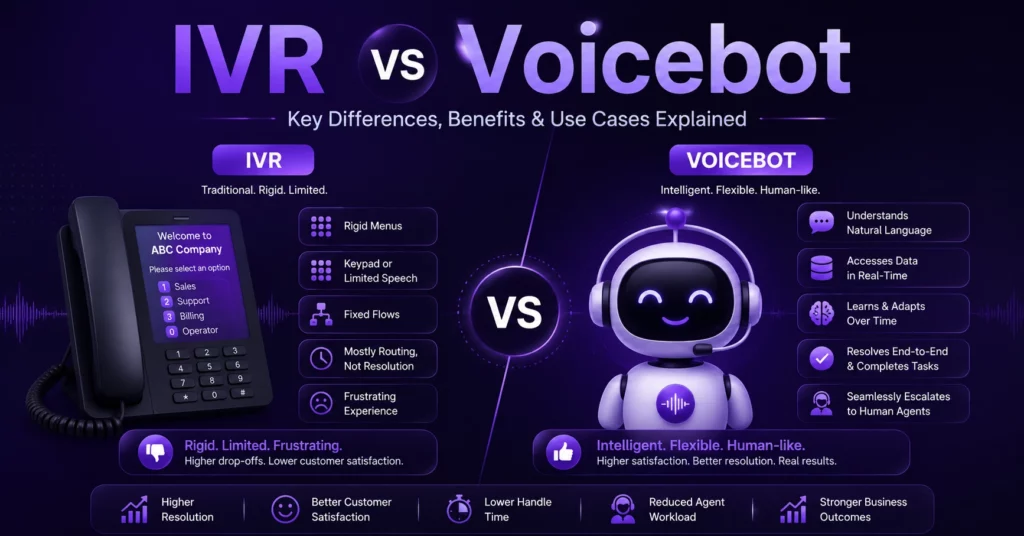
Customer behaviour has shifted faster in the last four years than in the previous twenty. Callers simply don’t tolerate rigid phone menus anymore, and many organisations are still playing catch-up. Teams that once thought IVR was “good enough” suddenly find their contact centres flooded with frustrated customers who want something much more natural.
This is where the ongoing debate of IVR vs Voicebot and voicebot vs conversational IVR becomes genuinely relevant, not as a technology comparison, but as a strategic decision.
Below is a detailed, practical, human-sounding analysis of what has actually changed, why it matters, and how modern voicebots are reshaping call automation.
What Exactly is IVR Today?
Most IVR systems were designed in an era when customer expectations were far lower. “Press 1 / Press 2” menus weren’t pleasant, but people accepted them as the only option. That tolerance has now faded.
A traditional IVR system:
- Plays prerecorded audio prompts
- Accepts keypad inputs (DTMF)
- Sometimes offers basic speech recognition
- Routes callers to queues or provides simple recorded info
- Works well only when the flow is predictable
IVRs shine in highly structured, low-variance use cases checking store hours, routing to departments, or collecting basic numeric inputs.
But that’s also the limitation. Customers don’t think in menus. They think in intent.
That mismatch is where modern dissatisfaction originates.
What is a Voicebot?
A voicebot is the next generation of automated voice interaction that’s powered by real NLP, intent detection, and in many cases LLMs. Instead of forcing callers into a tunnel of choices, a voicebot lets them speak freely:
- My package hasn’t arrived.
- I want to know why my bill increased.
- Can you unblock my card?”
- I need to reschedule an appointment.
The system understands the meaning, not just the words.
Voicebots can also:
- Pull data from CRM or ERP
- Perform tasks like updating records or booking slots
- Remember context across turns
- Personalize responses based on caller profiles
- Escalate smoothly to human agents
A good voicebot feels closer to a well-trained support agent than an automation tool.
Voicebot vs Conversational IVR
A conversational IVR is a halfway point. It lets callers speak instead of pressing keys, but it is still bound to fixed flows.
Conversational IVR ≠ Voicebot.
A conversational IVR:
- Recognizes limited phrases
- Maps those phrases to predefined options
- Still depends on a rigid decision tree
- Cannot handle unstructured intent
A voicebot:
- Understands open-ended speech
- Learns and adapts
- Handles multiple follow-up questions
- Can execute tasks end-to-end
A simple way to put it:
Conversational IVR = upgraded menu
Voicebot = intelligent assistant
Comparison Table: IVR vs Voicebot
| Dimension | IVR | Voicebot |
|---|---|---|
| Interaction Style | Keypad or limited speech | Natural language |
| Flexibility | Low | High |
| Handles Complex Queries | No | Yes |
| Personalization | Minimal | Deep (CRM-driven) |
| Learning Over Time | No | Yes |
| Cost to Deploy | Lower | Moderate |
| Long-term ROI | Low to medium | High |
| Customer Satisfaction | Inconsistent | Strong |
| Resolution Ability | Mostly routing | End-to-end tasks |
Why the Market is Moving Away from IVR
Let’s be honest, people dislike IVRs because of:
- Too many menu layers
- Repeating the same information multiple times
- Inability to explain an issue naturally
- “I just want to talk to someone” fatigue
- Accidental disconnections
- Needing to restart the entire flow after a mistake
The friction directly translates to:
- Higher call abandonment
- Lower CSAT
- Longer handle times
- Increased load on agents
- Negative brand perception
In contrast, a well-trained voicebot removes most of these pain points because it adapts to the caller rather than the other way around.
Where IVRs Still Make Sense
Although voicebots are clearly more capable, IVRs still have their place. For example:
- Very small businesses with low call volume
- Simple queries such as store hours, address, or basic routing
- Environments with strict, linear processes
- Extremely cost-sensitive scenarios
IVR is not obsolete, but it has a narrow sweet spot now.
Where Voicebots Deliver Outsized ROI
When enterprises evaluate voicebot vs IVR, the switch becomes obvious in a few high-impact situations:
1. High call volumes with repeated queries
Order status, delivery issues, payment confirmations, balance enquiries are the areas where voicebots excel.
2. Industries where personalization is critical
Insurance, healthcare, banking, telecom are the industries where customer history matters. Voicebots can access it instantly.
3. Multilingual and regional language environments
Voicebots are important specially in countries where customers mix two or more languages in one sentence.
4. 24/7 support without scaling headcount
A voicebot never sleeps, never burns out, never gets overwhelmed during peaks.
5. Task completion, not just routing
Booking appointments, updating contact details, resetting passwords, all these things are handled independently by voicebots.
Practical Examples of Voicebot Use Cases
- Booking and rescheduling appointments
- Checking insurance claim status
- Troubleshooting DTH/telecom issues
- Banking workflows (card reset, limit check, EMI)
- Ecommerce order tracking
- Logistics delivery coordination
- Lead qualification for sales teams
- Healthcare pre-screening and appointment reminders
These use cases have measurable outcomes, reduced support load, higher containment, lower AHT, and improved customer delight.
A Realistic Voicebots Adoption Strategy for Enterprises
Too many organizations underestimate the planning required for voicebot deployments. Here’s what mature teams actually follow:
Stage 1: Discovery
- Listen to actual call recordings
- Identify 15–20 high-volume intents
- Note frustration points and data required
Stage 2: Pilot
- Start small (one or two use cases)
- Build the bot with real utterances
- Integrate with CRM only where necessary
Stage 3: Optimization
- Improve intent detection
- Add disambiguation logic
- Make fallback flows smooth
Stage 4: Scale
- Introduce multilingual support
- Add transactional abilities
- Expand to Tier-2 and Tier-3 queries
The most successful deployments treat the voicebot as a living system, not a one-time rollout.
ConvoZen: A Modern Platform for AI Voice Automation
While many global platforms talk about conversational AI, only a few understand markets with diverse accents, code-mixing, and inconsistent audio quality. This is where ConvoZen stands out.
Unlike generic voicebot vendors that focus purely on ASR or NLP, ConvoZen positions itself as a full-stack enterprise voice automation platform, offering:
- Multilingual + code-mixed support
- Interruptible conversation design
- Deep integration with CRMs, ticketing, and policy systems
- Industry-specific solutions for insurance, banking, retail, and healthcare
- Real-time agent assists for hybrid teams
- Analytics and call summarization for compliance and insights
What makes ConvoZen interesting is the modularity. Enterprises can begin with simple FAQ automation and organically evolve into full workflow automation without rebuilding the system.
In short, ConvoZen bridges the gap between “we want a voicebot” and “we want it to actually work in the real world.”
If your goal is simply to route calls, IVR is enough. If your goal involves reducing call center load, improving customer satisfaction, handling high-volume repeated queries, supporting multiple languages, performing actual tasks, and shouldering peak-time demand then a voicebot is the clear winner.
The real transformation happens when businesses start seeing voicebots as digital frontline agents that are capable, scalable, and surprisingly close to human-level interaction.
Those who move early gain a structural advantage: faster service, lower costs, and happier customers.
FAQs for IVR vs Voicebots
Yes, especially if you care about resolution and customer experience. IVR is still fine for very simple routing.
No, conversational IVR just replaces keypresses with speech. Voicebots understand intent and handle multi-step tasks.
Modern ASR models are dramatically better at noise handling. While not perfect, they outperform older IVRs by a wide margin.
No, it can handle 40–70% of volume in many industries, but nuanced human issues require human empathy.
Initial setup costs are higher than IVR, but long-term savings are significantly higher due to automation and containment.
Platforms like ConvoZen specialize in multilingual and code-mixed speech, which is a major requirement in regions like India.