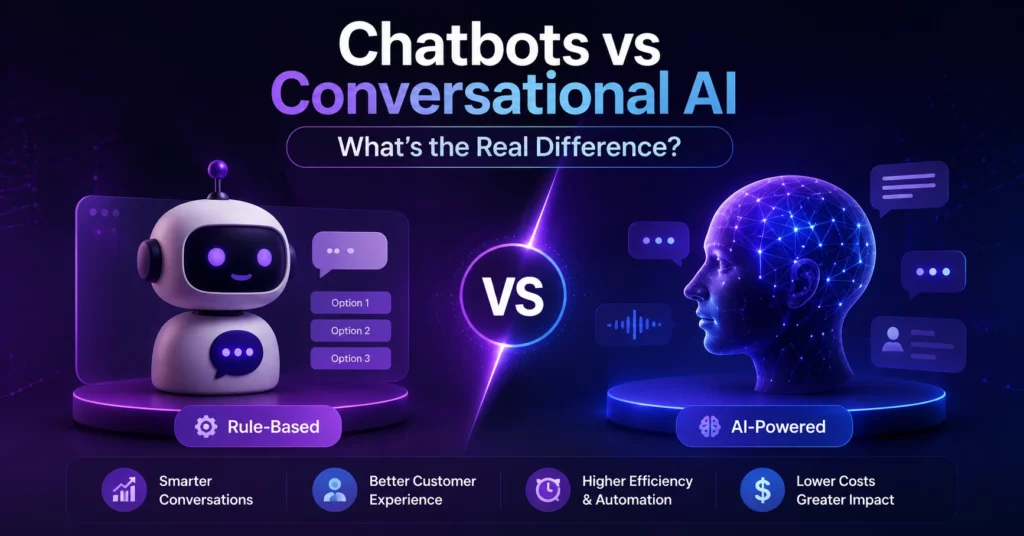
Often people use chatbots and conversational AI interchangeably, however these terms are pretty different under the hood. Chatbots are best for simple and scripted tasks. While on the other hand conversational AI is trained to handle advanced and flexible conversations. Understanding the difference between them will help you pick the right tool for your customer service needs.
What is a Chatbot?
Chatbot is a software designed to carry conversations with users through text or voice interactions. Traditional chatbots are usually built using predefined rules and workflows. You can think of a chatbot as a digital FAQ assistant that responds to specific commands or keywords and guides users through structured conversation paths.
And if a customer asks something outside the programmed flow, the chatbot may fail to understand the query.
For instance:
- User: “I want to change my address because it is wrong”
- Chatbot: “Your order has been packed, can’t change the address”
- User: “But I can’t receive it, its at the wrong address”
- Chatbot: Your order is out for delivery
This happens because the bot cannot fully understand intent or context.
Types of Chatbots
| Chatbot Type | How It Works | Best Use Cases | Key Strength | Limitation |
| Rule-Based Chatbots | Follow predefined flows using if/then logic and scripted responses. | FAQs, ticket routing, basic customer support. | Reliable and easy to control. | Struggle with unexpected or complex queries. |
| AI Chatbots | Use NLP and machine learning to understand user intent and conversational context. | Customer support, lead qualification, personalized assistance. | Can handle varied and natural conversations. | Require training data and ongoing optimization. |
| Menu-Based Chatbots | Let users interact through buttons, menus, or selectable options instead of typing. | Appointment booking, guided navigation, simple service flows. | Extremely simple and user-friendly. | Limited flexibility for open-ended conversations. |
| Voice Chatbots | Interact through spoken language on phones, apps, or smart devices. | IVR systems, virtual assistants, hands-free support. | Fast and convenient for voice-first experiences. | Accuracy can drop with accents, noise, or unclear speech. |
| Hybrid Chatbots | Combine rule-based workflows with AI-driven understanding and automation. | Advanced customer service, sales assistance, enterprise automation. | Balances structure, flexibility, and scalability. | More complex to design and maintain. |
What is Conversational AI?
Conversational AI is a broader and more advanced technology framework that enables machines to understand, process, and respond to human conversations naturally.
Unlike traditional chatbots, conversational AI uses technologies like:
- Natural Language Processing (NLP)
- Machine Learning (ML)
- Large Language Models (LLMs)
- Speech recognition
- Sentiment analysis
The goal is to create human-like conversations instead of scripted interactions.
Key Features of Conversational AI
Modern conversational AI platforms offer:
a. Human-Like Conversations
AI understands intent instead of relying only on keywords.
b. Context Awareness
The system remembers previous messages and maintains conversation flow.
c. Multilingual Support
Users can communicate in multiple languages naturally.
d. Personalisation
AI tailors responses based on user behavior and history.
e. Omnichannel Communication
Conversations continue across:
- Voice calls
- Chat
- Mobile apps
- Websites
f. Continuous Learning
AI systems improve accuracy over time.
Chatbots vs Conversational AI: Key Differences
Here’s the simplest way to understand the difference between chatbot and conversational AI:
| Feature | Chatbot | Conversational AI |
| Technology | Rule-based | AI-powered |
| Understanding | Keyword matching | Intent + context understanding |
| Responses | Predefined | Dynamic |
| Learning Ability | Limited | Continuously improves |
| Personalization | Basic | Advanced |
| Context Retention | Minimal | Strong |
| User Experience | Transactional | Human-like |
| Voice Support | Limited | Advanced voice AI |
| Language Support | Usually limited | Multilingual |
| Complexity Handling | Simple queries | Complex conversations |
In simple terms:
- A chatbot follows instructions.
- Conversational AI understands conversations.
Chatbots vs Conversational AI for Customer Support
Customer support is one of the biggest use cases for conversational AI today.
Traditional chatbots are useful for handling repetitive FAQs, but modern support teams need more intelligent automation.
That’s where platforms like ConvoZen.AI help businesses move beyond scripted bots.
With conversational AI capabilities, businesses can:
- Automate customer conversations at scale
- Deploy AI voice agents
- Enable multilingual customer interactions
- Assist support agents in real time
- Analyze customer sentiment
- Improve response quality and compliance
Instead of simply answering questions, conversational AI platforms help businesses create intelligent customer engagement systems.
Industry-Wise Implementation of Chatbot and Conversational AI
In 2026 the trends have changed from generic – “one size fits all” use cases towards fine-tuned on specialized data for a particular industry or process. Let’s understand with a few examples:
1. Banking and Insurance
AI chatbots have come a long way – the world of finance, chat they’re no longer just about telling in your account. Now, they can tell you how much money you have handled complicated tasks on their own, like checking if a warranty is still valid, giving refunds, and even negotiating settlements within certain limits. For example, insurance companies use special chatbots to deal with requests for proposals, which involves finding the right information from policies and pointing out any gaps that need a look at. This is a human expert for a tough job that requires a lot of thinking and understanding, way beyond what a regular chatbot can do.
2. Healthcare Diagnostics and Patient Management
Healthcare providers are now using special tools called SLMs to get important information from medical records while keeping patient data safe and private. This is a big deal because it helps them follow the rules set by HIPAA. With the help of new technology, like ChatGPT, doctors can use special computer programs to predict how well patients will respond to treatment and even diagnose rare diseases more accurately than ever before. Patients can also talk to computer agents that are smart and can understand how they’re feeling, which helps with things like scheduling appointments and making sure urgent cases get to the right doctors quickly, all without needing a human administrator to get involved.
3. Retail, Supply Chain, and Logistics
Retail leaders use conversational AI to drive hyper-personalization, utilizing real-time behavioral data to deliver recommendations that resonate with individual interaction patterns.19 In the supply chain, agentic systems monitor real-time weather and geopolitical signals to autonomously reroute logistics or reorder stock to prevent disruptions across volatile global networks.
How ConvoZen Uses Conversational AI
Imagine a customer calls to complain about a payment that failed. They are quite upset, don’t want to be transferred three times, and have already attempted to use the app. An example of a traditional bot is one that asks to press 1 for billing.
For a more advanced, flexible bot that uses AI for conversation, such a bot would pick up on how frustrated the customer was, and using AI, would pull up the customer’s app history to determine what the problem was and attempt to resolve the issue. If that bot was unable to resolve the issue, it would then provide all of the background context to the correct support person.
That use case describes the type of conversation that ConvoZen is designed to handle.
ConvoZen is capable of understanding the context of the situation and using that information to effectively assist the customer, instead of just pushing them to a new support channel.
The workflow also tracks sentiment in real time, meaning it is capable of monitoring the status of the call while the call is in progress. It also uses AI to provide support to the call’s representative before that representative has to think of a possible response.
The workflow can capture all Indian regional languages. It has the capability to provide support to a customer in the language which the customer prefers. Due to its monitoring and tracking capabilities, support teams are able to identify the overall status of the support calls and customer satisfaction without having to monitor those calls.
The purpose of designing this workflow is not to replace the support representatives, but to assist them by providing the required context and background support to the representatives in real time, and in the customer’s preferred language, to help them assist the customer more effectively.
Which is Better: Chatbot or Conversational AI?
The answer depends on your business needs.
Choose a Chatbot If:
- You need simple automation
- Your workflows are predictable
- You mainly handle FAQs
- Budget is limited
- You want quick deployment
Choose Conversational AI If:
- You need personalized customer experiences
- You handle complex conversations
- You require voice AI support
- You operate across multiple languages
- You want scalable customer engagement
- You need intelligent automation
For many enterprises, the ideal solution is a hybrid approach that combines chatbot workflows with conversational AI intelligence.
The debate around chatbots vs conversational AI is not really about which technology is “better.” It’s about choosing the right solution for the right business problem.
Chatbots are excellent for simple, structured automation.
Conversational AI goes much further by enabling intelligent, human-like, and context-aware interactions across voice and chat channels.
As customer expectations continue to evolve, businesses are increasingly moving toward conversational AI platforms that combine automation, personalization, and real-time intelligence.
ConvoZen is helping organizations transform customer conversations with AI voice agents, conversational analytics, and intelligent support automation designed for modern customer experiences.
FAQs for Chatbot vs Conversational AI
Typically, chatbots rely on predefined scripts while conversational AI incorporates the use of NLP and ML for a more natural response.
ChatGPT falls under the larger umbrella of conversational AI and is powered by large language models.
Certainly not. The majority of older or more traditional chatbots do not fall under the conversational AI category.
A conversational agent is an AI that understands conversation and can take an action, not just a response.
For more current customer support use cases, conversational AI is far more preferable due to its ease of contextual understanding, personalisation, and scalability.