
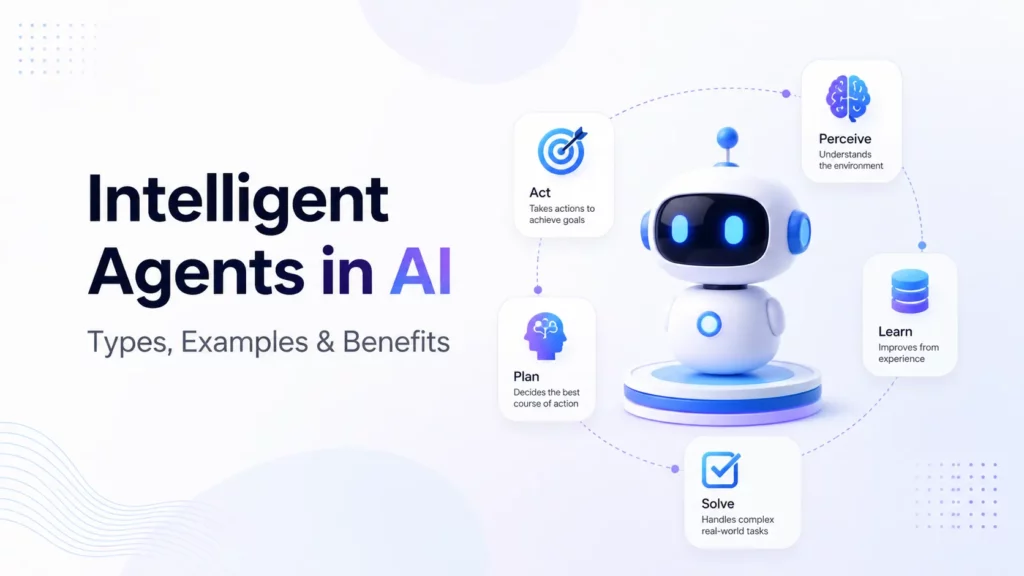
Support and operations teams increasingly want AI systems that can act independently, handling queries, routing issues, updating records, and flagging risks without waiting for a human to initiate each step. The challenge is knowing what these systems should observe, decide, and execute safely. This is where the concept of an intelligent agent in AI becomes practically important.
An intelligent agent is an AI system that senses its environment, processes information, makes decisions, and takes actions to achieve a defined goal. T
What Is an Intelligent Agent in AI?
An intelligent agent in AI is a system that observes its environment, processes information, makes decisions, and takes actions to achieve a goal.
The key distinction from basic automation is agency. A rule-based automation system follows a fixed script: if X happens, do Y. An intelligent agent does more. It perceives changing inputs, holds some representation of its current context, evaluates options, selects actions, and can improve its behaviour over time based on feedback.
The core traits that define an intelligent agent are:
- Autonom- it operates without requiring a human to direct every step
- Goal orientation- its decisions are directed toward achieving a defined outcome
- Adaptability- it can adjust responses based on changing inputs or context
- Feedback-based improvement– it can update its behaviour based on outcomes, corrections, or new data
AI Agent vs Chatbot: Where Intelligent Agents Fit
These terms are often used interchangeably but they describe different things:
- A chatbot primarily responds to user messages, typically following a decision tree or a language model that produces a reply. It does not necessarily take action, hold state across sessions, or use external tools.
- Rule-based automation follows fixed instructions with no interpretation of intent or context.
- An AI agent can understand context, make decisions, use tools, trigger actions in external systems, and handle multi-step tasks without a human directing each step.
- An intelligent agent is the broader AI concept behind all of these, a system designed to perceive, reason, and act within an environment toward a goal.
A customer support chatbot that answers a FAQ is not necessarily an intelligent agent. A system that reads customer intent, retrieves the right policy, generates a response, updates the CRM record, and flags the conversation for supervisor review if sentiment turns negative, that is closer to what an intelligent agent looks like in practice.
How Intelligent Agents Work: Structure and PEAS Framework
Intelligent agents work through a loop where they collect input, understand context, choose an action, execute it, and improve through feedback.
The structural components of an intelligent agent typically include:
- Sensors or input sources, the channels through which the agent receives information (voice, text, data feeds, API calls, conversation history)
- Perception layer, the component that interprets raw input into meaningful context
- Knowledge base or memory, stored information the agent can draw on, including past interactions, approved documents, or system state
- Decision logic, the rules, models, or reasoning process that selects an action
- Actuators or action systems, the mechanisms through which the agent takes action (sending a reply, updating a record, routing a call, triggering a workflow)
- Feedback loop, the mechanism that allows the agent to evaluate outcomes and improve
PEAS Framework for Intelligent Agents
PEAS is a standard framework for defining how an intelligent agent operates. It stands for Performance Measure, Environment, Actuators, and Sensors.
Using a customer support AI as a concrete example:
| PEAS Component | Definition | Customer Support AI Example |
| Performance Measure | How success is judged | Accurate resolution, safe escalation, response quality, compliance adherence |
| Environment | Where the agent operates | Voice calls, chat, email, WhatsApp, CRM, knowledge base |
| Actuators | How the agent takes action | Send reply, route issue, update ticket, trigger follow-up workflow |
| Sensors | How the agent collects input | Customer message, call transcript, intent signal, sentiment score, customer profile |
Defining PEAS clearly before building or evaluating an agent helps teams set measurable goals, identify data requirements, and establish the boundaries of what the agent should and should not do autonomously.
Types of Intelligent Agents in AI
The types of intelligent agents differ by how they use context, make decisions, evaluate outcomes, and learn from feedback.
| Agent Type | How It Works | Best Use Case | Main Limitation |
| Simple reflex agent | Reacts to current input using fixed rules | Simple, predictable tasks with clear triggers | No memory or context; fails in ambiguous situations |
| Model-based agent | Uses an internal state or memory of the environment | Partially visible environments where history matters | Needs accurate and up-to-date state tracking |
| Goal-based agent | Chooses actions based on a target goal and plans steps toward it | Planning and multi-step workflow execution | May require more computation; goal conflicts need resolution |
| Utility-based agent | Chooses the best action based on a value or scoring function | Decision-making with trade-offs between multiple options | Needs clearly defined scoring logic and reliable data |
| Learning agent | Improves from feedback, experience, and incoming data | Adaptive AI systems in changing environments | Requires monitoring, quality data, and guardrails |
Most production AI systems combine elements of more than one type. A contact centre voice agent, for example, may use model-based memory to maintain conversation context, goal-based logic to drive toward resolution, and a learning component that improves response quality over time based on supervisor feedback.
Applications of Intelligent Agents in Business Operations
Intelligent agents are useful when AI systems must understand changing inputs, make repeatable decisions, and take action across real workflows.
Customer Service and Contact Centre AI
Contact centres are one of the most active deployment environments for intelligent agent concepts. The workflows are well-defined, the data is rich, and the cost of poor decisions is immediately visible.
In this environment, intelligent agents can:
- Understand customer intent from voice, chat, email, or WhatsApp
- Answer common questions by retrieving information from an approved knowledge base
- Route issues to the right team or agent based on intent and context
- Support human agents with real-time suggestions, relevant context, and next-best-action recommendations during live calls
- Trigger workflow actions such as updating a CRM record, scheduling a callback, or sending a follow-up message
- Monitor sentiment, detect escalation signals, and flag compliance risks across 100% of interactions
ConvoZen applies intelligent agent concepts across this stack through three layers: Conversational AI Agents that handle customer interactions autonomously across voice, WhatsApp, and email; Copilot AI Agents that support human agents in real time during live calls; and Supervisor AI Agents that review interactions, surface sentiment and compliance risk, and generate performance insights across every conversation.
Other Business Applications
Intelligent agents are deployed across many other domains:
- E commerce, recommendation engines that observe browsing behaviour, infer intent, and surface relevant products or offers
- Finance and banking, fraud detection agents that monitor transaction patterns, flag anomalies, and trigger review workflows in real time
- Healthcare, decision support agents that assist clinicians by surfacing relevant patient history, drug interaction data, or clinical guidelines
- IT support, agents that monitor system health, diagnose common issues, and resolve or escalate incidents without manual triage
- Robotics and manufacturing, autonomous systems that perceive physical environments and execute precise, adaptive actions
- Smart home and IoT, devices that learn usage patterns and adjust settings, energy use, or alerts based on observed behaviour
Benefits, Limitations, and Evaluation Checklist for Intelligent Agents
Intelligent agents can improve speed, consistency, and scale, but they need clear goals, reliable data, monitoring, safety controls, and human oversight.
Benefits of Intelligent Agents
- Faster task handling, agents operate continuously and respond to inputs without the delays inherent in human workflows
- Consistent decision-making, the same logic applies every time, reducing variability caused by fatigue, mood, or training inconsistency
- Scalable support, one agent configuration can handle thousands of concurrent interactions where a human team cannot
- Better use of context, agents can draw on conversation history, customer data, and retrieved knowledge simultaneously, producing more relevant responses
- Continuous improvement, learning agents can refine their behaviour based on feedback, supervisor corrections, or outcome data over time
- Better personalization, agents with memory and context can tailor responses to individual customer history and preference
Limitations and Risks of Intelligent Agents
- Poor data quality, agents are only as reliable as the data they operate on; outdated, incomplete, or biased inputs produce poor decisions
- Wrong or biased decisions, models trained on historical data can reflect and amplify existing biases in ways that are difficult to detect
- Lack of explainability, some agent decision processes are opaque, making it hard to audit why a specific action was taken
- Privacy and compliance concerns, agents that process sensitive customer data must operate within clearly defined governance frameworks
- Over-automation, deploying agents in workflows that require human judgement or empathy without appropriate escalation logic creates risk
- Weak escalation logic, an agent that cannot recognise when it is out of its depth and fails to hand off cleanly causes more damage than no agent at all
- Performance drift, agent quality can degrade over time if knowledge sources become stale, inputs change, or the model is not monitored
- Difficulty monitoring across systems, agents that act across multiple platforms and tools can be hard to audit comprehensively without centralised oversight
Evaluation Checklist Before Adoption
Before deploying an intelligent agent in a live workflow, work through the following:
- What specific goal should the agent achieve, and how will success be measured?
- What environment will it operate in, and what inputs will it receive?
- What data does it need, and is that data clean, current, and accessible?
- What actions is it permitted to take, and what actions are outside its scope?
- What should happen when the agent’s confidence is low or the situation is ambiguous?
- When should a human take over, and how will the hand-off work?
- How will performance be monitored on an ongoing basis?
- How will the agent be tested with real queries before full deployment?
- What compliance, privacy, or regulatory controls apply to this workflow?
Intelligent agents are not just chatbots or simple automation scripts. They are AI systems designed to observe, decide, act, and improve within a defined environment. For businesses, the real value comes from applying them to the right workflows with clear goals, measurable outcomes, monitoring, and responsible oversight.
FAQs About Intelligent Agent in AI
An intelligent agent is an AI system that senses its environment, processes information, and takes action to achieve a goal.
The main types are simple reflex agents, model-based agents, goal-based agents, utility-based agents, and learning agents.
The structure usually includes sensors, a perception layer, memory or knowledge base, decision logic, actuators, and a feedback loop.
PEAS stands for Performance Measure, Environment, Actuators, and Sensors. It is a framework for defining how an intelligent agent operates in a given context.
A chatbot can be part of an intelligent agent system, but not every chatbot is an intelligent agent. Intelligent agents can reason, use context, take actions across systems, and improve through feedback, capabilities that go beyond a standard chatbot response loop.